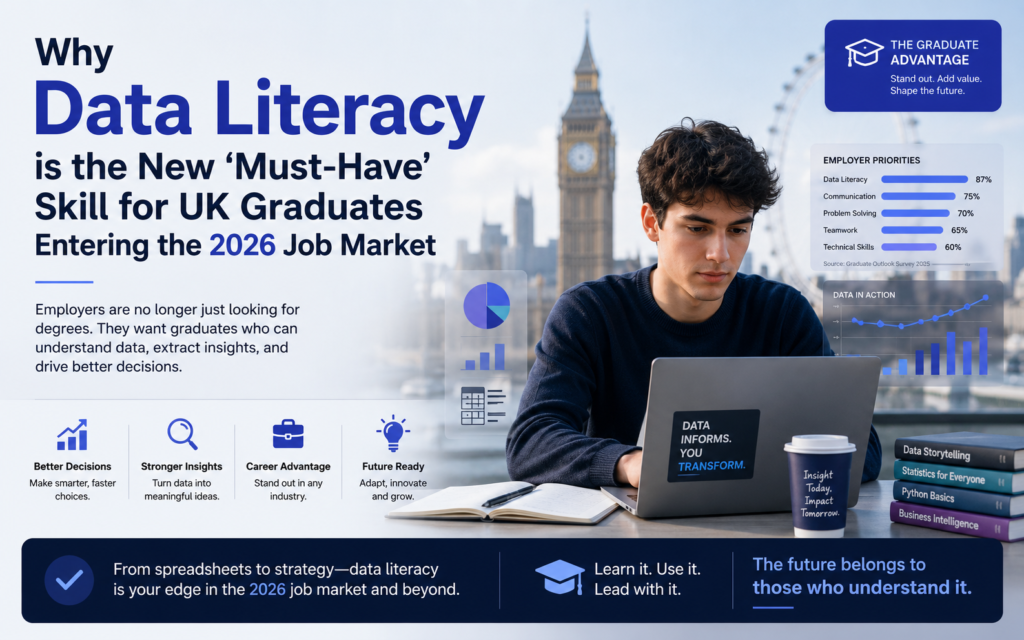

The transition from university life to a professional career has always been a significant leap. However, for the UK graduating class of 2026, the landscape looks remarkably different than it did even five years ago. We are currently witnessing a massive shift where traditional degrees are no longer enough to secure a top-tier role. Across London’s financial hubs, Manchester’s growing tech scene, and the engineering firms of the Midlands, one specific capability stands above the rest: data literacy.
Data literacy is the ability to read, work with, analyze, and argue with data. It is no longer a niche requirement for computer scientists or statisticians. Today, whether a graduate enters marketing, healthcare, law, or the creative arts, they are expected to interpret complex datasets to make informed decisions. The modern workplace moves at a pace that requires every team member to understand the “why” behind the numbers.
The Evolution of the UK Workplace in 2026
The rapid integration of predictive analytics and automated systems into daily business operations has changed the entry-level job description. Employers are no longer impressed by a basic understanding of spreadsheets. They want graduates who can look at a dashboard and identify trends, anomalies, and opportunities. This shift is driven by the sheer volume of information businesses now collect. From consumer habits to supply chain efficiency, data is the fuel for growth.
For many students, the pressure to master these technical skills alongside their core subjects is overwhelming. Balancing a final-year dissertation with the need to learn Python or R for data modeling creates a heavy academic burden. This is often when students look for professional assignment writing services to manage their existing workload, allowing them the breathing room to focus on these critical future-ready skills.
Why Every Sector is Now a “Data Sector”
It is a common misconception that data literacy only applies to STEM fields. In 2026, the humanities and social sciences are equally reliant on quantitative evidence.
Marketing and Communications: Modern PR and advertising are entirely driven by engagement metrics and sentiment analysis. A marketing graduate must understand how to pivot a campaign based on real-time data.
Healthcare and Nursing: The NHS and private healthcare providers now use big data to predict patient outcomes and manage resources. New graduates must be comfortable navigating digital health records and diagnostic statistics.
Legal Services: Law firms are increasingly using data to predict case outcomes and streamline discovery. Understanding legal tech is now as important as knowing case law.
Environmental Science: With the UK’s focus on Net Zero goals, environmental graduates must handle massive climate datasets to propose sustainable solutions.
The Skills Gap: Theory vs. Practical Application
While UK universities provide a world-class theoretical foundation, there is often a gap when it comes to practical data application. Employers frequently report that while graduates know the “textbook” version of their subject, they struggle when handed a messy, real-world dataset.
This gap is precisely why self-study and specialized coursework have become so popular. Students are increasingly taking it upon themselves to learn how to visualize data and communicate findings to non-technical stakeholders. When the academic pressure of these extra certifications becomes too much, many choose to hire experts to do my coursework so they can dedicate their energy to mastering data visualization tools like Tableau or Power BI.
Human Intuition in a World of Algorithms
A vital part of data literacy that often gets ignored is the “literacy” aspect—the ability to tell a story with data. Algorithms can crunch numbers, but they cannot provide context. They cannot explain the cultural nuances of a UK consumer or the ethical implications of a business decision.
Graduates who possess both the technical skill to pull data and the human empathy to interpret it are the ones who will lead in 2026. This “Experience and Expertise” is what separates a mediocre employee from a future leader. Being able to look at a statistical report and say, “The numbers suggest X, but our community values Y,” is a high-level skill that remains uniquely human.
Preparing for the Interview of Tomorrow
If you are a student preparing to graduate, your resume needs to reflect your data journey. Do not just list “proficient in Microsoft Office.” Instead, highlight specific projects where you used data to solve a problem. Did you analyze social media trends for a university society? Did you use data to improve the efficiency of a part-time job? These real-world examples prove your “Trustworthiness” and practical ability to potential employers.
Furthermore, the 2026 job market values continuous learning. Showing that you have stayed updated with the latest trends in your industry demonstrates a proactive mindset. In an era where technology changes every few months, the ability to learn is the most sustainable skill you can have.
Conclusion
Data literacy is the common thread that connects every successful career in the modern UK economy. It is the language of business, science, and social progress. While the transition from student to professional is challenging, focusing on the ability to interpret information will provide a massive competitive advantage. By balancing your core academic requirements with these practical digital skills, you ensure that you are not just ready for a job, but ready for a career that can withstand the changes of the next decade.