
Linux gaming is no longer a small corner of the gaming world. It has become a serious platform for players who want freedom, control, privacy, and strong performance without depending completely on Windows. With Steam, Proton, Wine, Vulkan, and community tools improving every year, Linux users now have more ways to play modern titles smoothly.
The idea behind Tech Hacks PBLinuxGaming is simple: use smart Linux gaming methods to improve compatibility, reduce lag, increase FPS, and create a smoother gaming setup. These hacks are not about unsafe shortcuts. They are about using the right tools, settings, drivers, and performance tweaks in a careful way so players can enjoy games with fewer problems.
What Is Tech Hacks PBLinuxGaming?
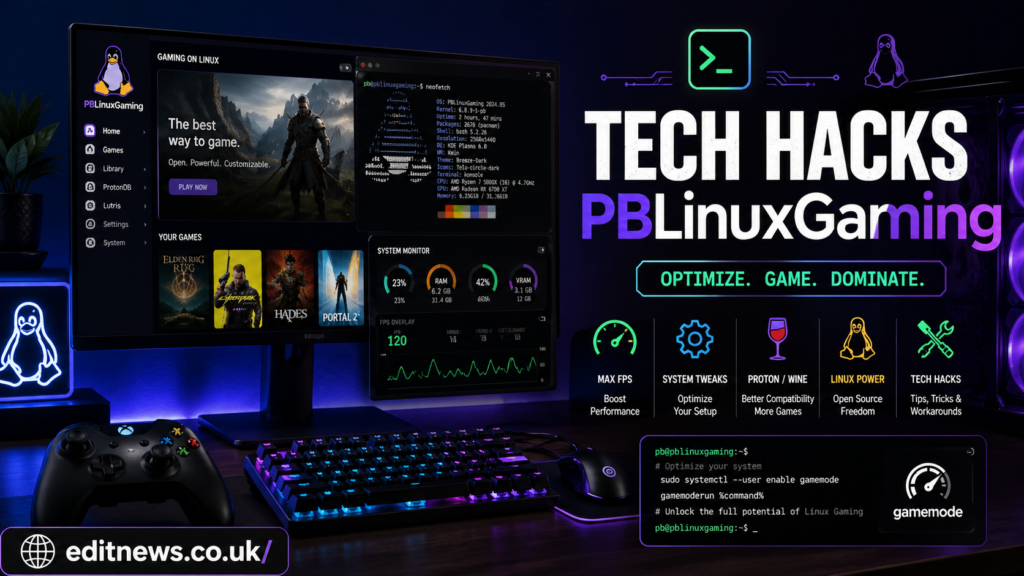
Tech Hacks PBLinuxGaming refers to a practical set of Linux gaming tips, tools, and system adjustments designed to improve the gaming experience. It includes using Proton for Steam games, Wine for non-Steam Windows games, GameMode for system optimization, MangoHud for performance monitoring, and driver updates for better graphics performance.
Linux gaming often needs more setup than Windows gaming because many games are originally built for Windows. Compatibility layers help bridge that gap. Valve describes Proton as a tool for the Steam client that allows Windows-exclusive games to run on Linux, using Wine as part of the process.
Why Linux Gaming Is Growing Fast
Linux gaming has grown because players want more control over their systems. Many users prefer Linux because it is open-source, customizable, lightweight, and privacy-friendly. For gamers who enjoy adjusting settings and improving performance, Linux offers a flexible environment that can be tuned more deeply than many traditional systems.
The Steam Deck also helped Linux gaming become more visible. Because Steam Deck runs on a Linux-based system, many players became curious about Proton, Steam Play, and compatibility tools. This shift encouraged more users to learn how Linux gaming works and how small adjustments can improve frame rates, stability, and loading times.
Why Performance Tweaks Matter on Linux
Performance tweaks matter because Linux gaming performance can vary from game to game. One title may run perfectly through Proton, while another may need a different Proton version, launch command, driver update, or graphics API setting. This is why Linux gamers often test different combinations before finding the best setup.
A good tweak can reduce stuttering, fix crashes, improve input response, and increase FPS. However, not every tweak is useful for every game. The best approach is to test one change at a time, measure results, and avoid random scripts or unstable settings that may damage system reliability.
Understanding Proton for Linux Gaming
Proton is one of the most important tools for modern Linux gaming. It allows many Windows games on Steam to run on Linux without requiring a native Linux version. Proton works inside Steam Play and helps translate Windows game requirements into something Linux can understand.
Proton is based on Wine and includes gaming-focused improvements from Valve and other contributors. Players often test different Proton versions, such as official Proton, Proton Experimental, or Proton GE, when a game does not launch properly or performs poorly. ProtonDB is useful because it gathers player reports and compatibility scores for games tested with Proton on Linux and Steam Deck.
How to Use Proton More Effectively
Using Proton effectively starts with checking compatibility before installing a game. ProtonDB reports can show whether a game runs well, needs launch options, has audio problems, or requires a specific Proton version. This saves time and helps users avoid unnecessary frustration.
Gamers should also remember that the newest Proton version is not always the best for every title. Some games work better with an older release, while others need Proton Experimental or Proton GE. Testing carefully is part of the Linux gaming process, especially when chasing stable FPS and smooth gameplay.
Wine and Its Role in Linux Gaming
Wine is another powerful tool for Linux users. It is especially useful for running Windows applications and non-Steam games. WineHQ explains that Wine is a compatibility layer that runs Windows applications on POSIX-compliant systems such as Linux, macOS, and BSD by translating Windows API calls instead of acting like a traditional emulator.
For gaming, Wine is often used through tools like Lutris, Bottles, and Heroic Games Launcher. These tools make Wine easier to manage by helping users create prefixes, install dependencies, choose Wine versions, and organize games from different platforms. This makes Wine useful for players who do not rely only on Steam.
Proton vs Wine for Gamers
Proton is usually the better choice for Steam games because it is directly connected to Steam Play and designed with gaming compatibility in mind. It includes many gaming-focused patches and works smoothly inside the Steam interface. For many users, enabling Proton in Steam is the easiest path to Linux gaming.
Wine is better for non-Steam games, older Windows software, custom launchers, and games from platforms outside Steam. It gives users more control, but it may also require more manual setup. A smart Linux gamer understands both tools and chooses the one that fits the game.
Best FPS Tweaks for Linux Gaming
FPS tweaks are a major part of Tech Hacks PBLinuxGaming because smooth gameplay depends on stable frame delivery. The first step is simple: update your GPU drivers, keep your system packages current, and make sure Vulkan support is installed. Many performance problems begin with outdated drivers or missing graphics libraries.
The next step is adjusting in-game settings. Lowering shadows, reflections, anti-aliasing, and texture quality can improve FPS without destroying visual quality. Players should also test fullscreen mode, borderless window mode, and refresh rate settings because these options can affect input delay, screen tearing, and overall smoothness.
Using GameMode for Better Performance
GameMode is a useful Linux performance tool created to apply temporary optimizations while games are running. Feral Interactive describes GameMode as a daemon and library combination that allows games to request optimizations for the host operating system or game process.
GameMode can help with CPU governor behavior, process priority, and performance-focused settings. It is often launched through Steam with a command such as gamemoderun %command%. While it will not magically double FPS, it can improve stability and reduce performance dips on some systems, especially older or CPU-limited machines.
Vulkan, DXVK, and VKD3D Explained
Vulkan is a modern graphics API that often performs well on Linux. Many Linux gaming tools rely on Vulkan because it can provide efficient rendering and better performance than older methods. When a Windows game uses DirectX, translation layers can help convert those graphics calls into Vulkan.
DXVK helps translate DirectX 9, 10, and 11 into Vulkan, while VKD3D helps with DirectX 12. These technologies are important because many Windows games are built around DirectX. Without them, Linux compatibility would be much weaker for modern gaming.
GPU Driver Optimization for Linux Gaming
GPU drivers are one of the most important parts of Linux gaming performance. AMD users often benefit from strong open-source Mesa driver support, while NVIDIA users usually need to choose the correct proprietary driver for best gaming performance. Intel graphics users should also keep Mesa updated for improved compatibility.
A driver problem can cause low FPS, stuttering, crashes, black screens, or missing Vulkan support. Before applying advanced tweaks, users should confirm that their graphics driver is correctly installed. A clean driver setup often solves more problems than complicated launch commands or risky configuration changes.
Best Linux Distros for Gaming
Choosing the right Linux distribution can make gaming easier. Ubuntu, Linux Mint, Pop!_OS, Fedora, Nobara, Garuda Linux, and SteamOS are commonly discussed among gamers because they offer different balances of stability, updates, driver support, and ease of use. Beginners usually benefit from a distro with strong documentation and simple driver installation.
Advanced users may prefer rolling or gaming-focused distributions because they often include newer kernels, Mesa updates, and performance tools. However, newer is not always better for every player. Stability matters, especially for users who want their gaming system to work consistently without constant troubleshooting.
Steam Deck and Linux Gaming Performance
Steam Deck changed the way many people view Linux gaming. It showed that a Linux-based device can deliver a console-like gaming experience while still using PC gaming tools. Because it relies heavily on Proton and Steam compatibility, it also introduced many players to the same concepts used on desktop Linux.
Steam Deck users can improve performance by adjusting TDP, limiting FPS, changing refresh rate, using FSR, managing storage, and testing different Proton versions. These changes can help balance battery life, heat, graphics quality, and frame stability. Desktop users can learn from many of the same optimization ideas.
Best Tools for Linux Gaming Optimization
A strong Linux gaming setup often includes several tools. Steam handles game libraries and Proton. ProtonDB helps players check compatibility reports. Lutris manages games from different sources. Bottles helps organize Wine prefixes. Heroic Games Launcher supports platforms like Epic Games and GOG. MangoHud displays FPS, frame time, CPU usage, GPU load, and temperature.
These tools make Linux gaming easier because they reduce guesswork. Instead of blindly changing settings, players can monitor performance and identify problems. The best setup is not always the most complicated one. It is the setup that gives stable results with the least unnecessary risk.
MangoHud for FPS and Performance Monitoring
MangoHud is useful because it shows real-time performance information while gaming. Instead of guessing whether a tweak worked, players can monitor FPS, frame timing, CPU usage, GPU load, VRAM usage, and temperatures. This helps users understand whether performance problems come from the CPU, GPU, memory, or game settings.
Monitoring is important because average FPS does not tell the full story. A game can show high FPS but still feel rough if frame times are unstable. MangoHud helps reveal stutters, thermal throttling, and hardware bottlenecks. For serious Linux gamers, measurement is better than guesswork.
Launch Options for Better Gameplay
Launch options can help Linux gamers apply specific fixes or performance tweaks. Steam allows users to add commands for individual games. Common examples include enabling GameMode, launching MangoHud, forcing specific graphics behavior, or collecting Proton logs for troubleshooting. These commands can be useful, but they should be used carefully.
The best method is to test one launch option at a time. If a player adds five commands at once, it becomes hard to know which command helped or caused a problem. Smart optimization means making small changes, testing the result, and keeping notes for each game.
Fixing Games That Do Not Launch
When a game does not launch on Linux, the first step is to verify the game files and restart Steam or the launcher. Then the player should test another Proton version. Proton Experimental or Proton GE may help some titles, while an older stable Proton version may work better for others.
If the game still fails, check ProtonDB reports, missing dependencies, launcher issues, and anti-cheat limitations. Some multiplayer games do not fully support Proton because of anti-cheat restrictions. In those cases, performance tweaks cannot solve the problem unless the developer enables Linux or Proton compatibility.
Fixing Low FPS on Linux
Low FPS can happen for many reasons, including outdated drivers, high graphics settings, wrong Proton version, weak hardware, shader compilation, or background processes. The best first step is to update drivers and confirm Vulkan support. Then lower demanding graphics options such as shadows, reflections, and anti-aliasing.
Players should also close unnecessary apps, enable GameMode, monitor performance with MangoHud, and test a different Proton version. If the GPU is always at full usage, lowering graphics settings may help. If the CPU is overloaded, performance mode and background process cleanup may be more useful.
Fixing Stuttering and Frame Drops
Stuttering can be more annoying than low FPS because it breaks the flow of gameplay. It may happen during shader compilation, map loading, asset streaming, or CPU spikes. Some games stutter the first time they run because shaders are being built in the background.
To reduce stutter, use an SSD, keep drivers updated, try Vulkan-based options when available, and allow shader pre-caching in Steam. Players should also avoid running too many overlays at once. A clean system with stable drivers often performs better than a heavily modified setup.
Controller and Input Fixes
Controller problems are common for Linux gamers, especially with non-Steam games or unusual controllers. Steam Input can help because it supports many controllers and allows custom button mapping. Players should check whether Steam Input is enabled globally or only for a specific game.
For non-Steam games, users may need additional tools or settings depending on the controller type. Bluetooth controllers can also introduce latency or connection problems. Wired connections often provide more stable input, especially for competitive games where every millisecond matters.
Audio Problems in Linux Games
Audio problems may include crackling, missing sound, wrong output device, or delayed audio. Modern Linux systems often use PipeWire, while older setups may use PulseAudio. Most problems can be fixed by checking the audio output device, restarting the audio service, or adjusting game-specific sound settings.
Some Proton or Wine games may need extra configuration if they expect specific Windows audio behavior. If a game has known audio problems, compatibility reports may show a solution. This is another reason why checking community reports before troubleshooting can save time.
Anti-Cheat and Multiplayer Limitations
Anti-cheat support remains one of the biggest challenges for Linux gaming. Many single-player and co-op games run well, but some competitive multiplayer titles block Linux or Proton because of anti-cheat systems. This is not always a Linux performance issue; it is often a developer or publisher support decision.
Players should check compatibility before buying multiplayer games specifically for Linux. ProtonDB and official game pages can help show whether a title works online. If anti-cheat is not enabled for Proton, no amount of FPS tweaking will make the game fully playable online.
Hardware Tips for Linux Gaming
Hardware still matters, even with the best software tweaks. A strong GPU, modern CPU, enough RAM, and an SSD can make a major difference. Linux can run well on older machines, but modern games still need capable hardware to deliver smooth performance.
For budget upgrades, an SSD is often one of the best improvements because it reduces loading times and helps with asset streaming. Adding more RAM can also help modern games and multitasking. Better cooling may prevent thermal throttling, especially on gaming laptops that run hot under load.
Laptop Gaming on Linux
Gaming laptops need special attention because they often include hybrid graphics, power-saving modes, and thermal limits. Users may need to confirm whether the game is using the dedicated GPU instead of integrated graphics. If the wrong GPU is active, performance can be much lower than expected.
Laptop users should also manage heat carefully. High temperatures can reduce CPU and GPU speeds, causing sudden FPS drops. Using performance mode, cleaning vents, updating drivers, and improving airflow can help. For long gaming sessions, stable cooling is just as important as software optimization.
Safe Optimization vs Risky Tweaks
Safe optimization includes driver updates, Proton testing, GameMode, graphics setting changes, MangoHud monitoring, and using trusted tools from official repositories. These steps are usually reversible and do not damage the system when applied correctly.
Risky tweaks include random scripts from unknown websites, aggressive overclocking, unstable kernel changes, or copying commands without understanding them. Linux gives users power, but that power should be used carefully. A stable gaming system is better than a fragile setup that breaks after every update.
Security Tips for Linux Gamers
Linux users should avoid downloading game fixes or scripts from unknown sources. Gaming communities are helpful, but not every command online is safe. Before running any command, users should understand what it does and whether it comes from a trusted source.
System snapshots can also help before major changes. Tools like Timeshift allow users to roll back if an update or tweak causes problems. This is especially useful for users who experiment with drivers, kernels, Wine versions, or gaming-focused system changes.
Building a Beginner-Friendly Linux Gaming Setup
Beginners should start with a stable Linux distribution, install Steam, enable Proton, update GPU drivers, and check ProtonDB before installing games. This simple setup is enough for many players. There is no need to install every advanced tool on the first day.
After the basics are working, beginners can add MangoHud, GameMode, Lutris, Bottles, or Heroic Games Launcher. This gradual approach reduces confusion. Learning Linux gaming step by step is better than copying a complicated setup that may not match the user’s hardware or games.
Advanced Tips for Experienced Linux Gamers
Experienced users can explore custom Proton builds, Wine prefixes, advanced launch options, kernel versions, CPU governors, and detailed performance logs. These methods can improve specific games, especially when official compatibility is not perfect. However, advanced tweaks should always be tested carefully.
Experienced gamers should also document their changes. Keeping notes about Proton versions, launch commands, driver updates, and game settings makes troubleshooting easier. When something breaks after an update, good notes can help identify the cause quickly.
Common Mistakes Linux Gamers Should Avoid
One common mistake is changing too many settings at once. When several tweaks are applied together, it becomes difficult to know which change helped or hurt performance. Another mistake is assuming every game needs Proton GE or advanced commands. Sometimes the default Proton version works best.
Another mistake is ignoring driver updates or compatibility reports. Many problems already have known solutions in community databases. Before reinstalling the system or applying risky commands, players should check game-specific reports, launcher settings, and basic driver health.
How to Test Linux Gaming Performance
Testing performance properly means looking beyond average FPS. Players should monitor frame times, temperature, CPU usage, GPU usage, memory usage, and stutter patterns. MangoHud can help show these details in real time while playing.
A good test should use the same map, same graphics settings, same resolution, and same gameplay situation before and after a tweak. This makes results more reliable. If conditions change too much, players may think a tweak worked when the difference came from the game environment.
Best Practical Workflow for Linux Game Optimization
A simple workflow works best. First, check whether the game is compatible. Second, install or update drivers. Third, test the game with default Proton. Fourth, monitor performance. Fifth, adjust graphics settings. Sixth, try GameMode or another Proton version if needed.
This workflow keeps the process organized. It also prevents unnecessary changes. Most Linux gaming problems can be solved through careful testing, not random tweaking. The goal is not to make the system complicated; the goal is to make games run better.
Why Tech Hacks PBLinuxGaming Is Useful for Modern Players
Tech Hacks PBLinuxGaming is useful because it gives Linux gamers a clear way to think about performance. Instead of treating every issue as a mystery, players can separate problems into categories: compatibility, drivers, graphics settings, system performance, storage, hardware, and anti-cheat support.
This structured approach saves time and reduces frustration. Linux gaming rewards patience and curiosity. Once users understand the basic tools, they can build a gaming system that feels fast, personal, and reliable. The more they learn, the easier future troubleshooting becomes.
Conclusion
Linux gaming has become stronger because of Proton, Wine, Vulkan, Steam Deck, GameMode, MangoHud, and active community support. Players now have more options than ever to run Windows games, improve FPS, reduce stutter, and customize their gaming experience.
Tech Hacks PBLinuxGaming is not about dangerous tricks or unrealistic promises. It is about smart optimization, careful testing, and using the right tool for the right problem. With updated drivers, proper Proton settings, safe tweaks, and performance monitoring, Linux gaming can be smooth, powerful, and enjoyable.
FAQs
What is Tech Hacks PBLinuxGaming?
Tech Hacks PBLinuxGaming means using practical Linux gaming tips, tools, and system tweaks to improve performance, compatibility, and stability. It includes Proton, Wine, GameMode, FPS monitoring, driver updates, launch options, and safe system optimization methods for smoother gameplay.
Is Proton better than Wine for Linux gaming?
Proton is usually better for Steam games because it is integrated into Steam Play and designed for gaming compatibility. Wine is better for non-Steam games, custom launchers, and Windows applications outside Steam. Many Linux gamers use both depending on the game.
How can I boost FPS on Linux?
You can boost FPS on Linux by updating GPU drivers, enabling GameMode, lowering heavy graphics settings, using Vulkan where possible, testing different Proton versions, closing background apps, and monitoring performance with MangoHud. Always test changes one at a time.
Why do some games not work on Linux?
Some games do not work on Linux because of anti-cheat systems, DRM restrictions, unsupported launchers, missing dependencies, or poor Proton and Wine compatibility. Multiplayer games with strict anti-cheat systems are often the most difficult to run through Linux.
What is the best Linux distro for gaming?
There is no single best distro for everyone. Beginners often prefer Ubuntu, Linux Mint, Pop!_OS, or Fedora because they are easier to use. More advanced gamers may prefer Nobara, Garuda Linux, or SteamOS-style setups for newer gaming tools and drivers.
Is Linux gaming good in 2026?
Yes, Linux gaming is much better than it was years ago. Proton, Steam Deck, Vulkan, Wine, and gaming-focused tools have improved compatibility and performance. However, some multiplayer games still have anti-cheat limitations, so players should check compatibility before buying.
Are Linux gaming tweaks safe?
Most basic Linux gaming tweaks are safe when they involve trusted tools, driver updates, GameMode, Proton testing, and graphics settings. Risky tweaks include random scripts, unstable drivers, aggressive overclocking, and commands copied from unknown sources without understanding them.
Does Steam Deck use Linux gaming technology?
Yes, Steam Deck uses a Linux-based system and relies heavily on Proton for many Windows games. Many Linux gaming ideas, such as Proton version testing, FPS limits, refresh rate tuning, and compatibility checking, also apply to Steam Deck users.
What tools should every Linux gamer know?
Every Linux gamer should know Steam, ProtonDB, Wine, Lutris, Bottles, Heroic Games Launcher, GameMode, and MangoHud. These tools help with compatibility, performance monitoring, game organization, non-Steam games, and system optimization.
Can Linux gaming replace Windows gaming?
Linux gaming can replace Windows gaming for many players, especially those who play compatible Steam games, indie titles, single-player games, and Steam Deck-supported games. However, players who depend on unsupported anti-cheat multiplayer titles may still need Windows for those games.